


Bottled by hand and sold at the front gate
SUMMERS, ARK. – Logos fill the grocery aisles, promising “farm-fresh” milk from multimillion-dollar corporations bigger than some of the towns in Arkansas. But down a gravel road in the small town of Summers, Dry Creek Dairy is proving that “fresh” still means what it always did: milk bottled by hand and sold at the front gate.
As more Americans begin to question where their food comes from and what’s in it, a quiet return to homesteading is reshaping rural life. At Dry Creek Dairy, the Sanford family is a part of that movement – milking their own cows, bottling by hand and selling straight from the farm.
The farm has been in the family for generations, but the reality of selling raw milk was not truly possible until April 2025 when the Arkansas governor signed into effect the bill allowing for sale of raw milk and raw milk products.
Brittney Cox-Sanford’s family has lived in Summers, Arkansas, and farmed the same land for generations.
“The original land belonged to my grandparents’ parents,” said Cox-Sanford. “They had 11 kids, and everybody ended up with their own section of land. What was left to my grandpa was around 80 acres.”
She said when her grandparents started farming the land they used a horse and plow and grew tomatoes. They had also decided they wanted to raise and sell pigs on some of the land.
“Selling pigs didn’t last long,” said Cox-Sanford. “As my grandma likes to tell the story, the last time we sold pigs, we sold them for a nickel apiece.”

After Cox-Sanford’s grandfather passed away in the 80s, her grandmother decided it was time for a change. She traded in the swine and tomatoes for beef cattle.
“She did all 80 acres by herself for a while, as a single lady, running beef cows,” said Cox-Sanford.
Her grandmother eventually remarried and passed on the family farm. Cox-Sanford’s grandmother originally planned to give 40 acres to her stepson and leave the other 40 for her daughter. Cox-Sanford’s mother had no use for the land, so Cox-Sanford inherited the land in her mother’s stead.
As a high school graduation present from her dad’s side of the family, she received a bred heifer and a promise that they would build up her herd while she was away at college.
Cox-Sanford graduated from Oklahoma State University with a degree in Agricultural Education. Before starting her career as an educator, she found out that she was expecting her first child and decided what was most important to her was staying at home, raising her children and running their family farm.
They remained a family-owned beef farm for around 12 years until her oldest moved from homeschooling and started public high school. Once in public school, Noah got involved in FFA and started showing dairy cows. He started with one heifer, but as he fell in love with it and was able to make a lot of money. He decided to put his earnings right back into showing and invested in a few more cows.
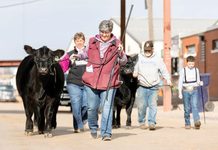
As Cox-Sanford’s three younger children, Brenna, Mercy and Hannah, watched their brother’s success in the fair circuit, they began to develop an interest in showing dairy heifers like their big brother.
“Once sister (Brenna) bought a couple, we had all these heifers that then become cows and we’ve got to do something,” said Cox-Sanford. “I couldn’t keep the beef herd separate from the dairy herd on 40 acres, so we opted to get rid of the beef herd. At least while all the kids are still into showing.”
Their main priority was and still is to raise dairy cows for show. The children pitch in and help to take care and provide for their cows. They are a part of the milkings and feedings, and they prepare their cows and heifers for shows.
Brenna, the oldest daughter at 11 years old, is the one out in the barn every morning and evening milking cows with her mom. She now has eight cows of her own and takes full responsibility for their health and breeding.
Any money that she earns from showing her cows is hers to keep. She puts some back into her the care of her cows or expanding her herd, but the rest she can save to spend on herself.
“I love showing. I think it’s awesome,” said Brenna. “I get to do something that I like, and at the end of last season, I had $8,000 in the bank and was able to go out and buy four more cows. I also got to go on a shopping spree.”
The Sanford family farm now has around 40 head and all six milking breeds, but they time their artificial insemination to ensure that no more than 12 cows are milking at a time, keeping the process manageable for the family.
Prior to April 2025, sale of raw milk in Arkansas was limited to no more than 500 gallons of milk and it was only able to be sold directly on farm.

Milking 12 cows at a time will produce upwards of 2,000 gallons of milk per month, according to research done by Oklahoma State University. The surplus milk, any milk produced over the 500 gallon limit that could be sold, they were unable to use in their own household or as supplement to calves, had to be dumped. This was thousands of gallons of milk going to waste each year.
“You have to milk cows to keep them pretty, and we might as well do something with the product,” said Cox-Sanford. “We have been an LLC since May (2025), and our goal is to turn a profit eventually. We hope to break even at the end of this year.”
With the new law passed in April, the goal for Dry Creek Dairy is now very close to reality. There is no longer a maximum amount of milk that is allowed to legally be sold, and the milk is now able to be sold and picked up at local farm stores.
As part of the law, every Mason jar of milk they sell will be labeled with their farm logo, location and an acknowledgement that the milk is unpasteurized.
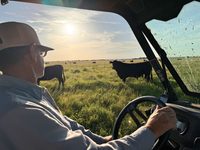
They sell their milk to friends, family and neighbors in their community. Milk can still be bought right at the gate, where the cows producing that milk can be seen grazing in the pasture, or it can be picked up from any of the three local farm stores that stock Dry Creek Dairy.
With “family-owned” and “farm-fresh” produce becoming a staple in fridges across the nation, consumers in Arkansas can rest assured that when they see the Dry Creek Dairy logo it really does represent a family-owned operation that prides itself on fresh, high-quality milk.