

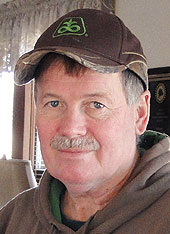
A Dairy Destiny
Don Crawley’s mother and father got married and settled land in 1922 outside of Maysville, Ark. Don said, “In the 1930s when I was a boy, life was milking a few cows and raising a few laying hens. Now we just do it on a bigger scale.” Don’s earliest agricultural memory is milking when he was in grade school and remembering the lack of milking machines which he believes was one of the best improvements in the industry over the years. Don also served in the military during World War II as a tail gunner and completed 47 missions over Germany. His work ethic and dedication greatly influenced his sons.
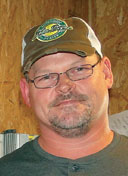
Twice the Livestock, Twice the Payoff
Jack and Tammy Simmons own and lease over 1,000 acres outside of Stilwell, Okla., on which they run a cow/calf operation and a brand new four-house Tyson chicken farm.

Putting on the Pounds
Like so many farmers in Arkansas, Jimmy and Janelle Brown of Natural Dam, Ark., live on a generational farm, in this case five generations. They own and lease just under 1,000 acres and run a full-time commercial cattle operation. Jimmy said, “For us, having land off the highway is as important as having better land.”
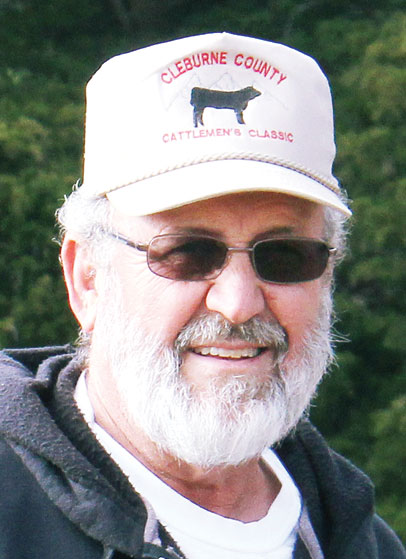
Life Long Cooperation
“That lane. That’s what I’m most proud of lately.” Larry and Deloris Wells of Drasco, Ark., began their herd building journey just a little over 43 years ago when they purchased the ground that lane divides, “We bought the place in November of 1971 from my uncle. He was in the broiler business and his health was forcing him to retire.” The Wells began with 55 cows and bulls and a modest 237 acres, with only 22 acres of that cleared for producing hay. It was an uphill battle from there, “There were no cross fences. We just started clearing and used the wood for the broiler houses at the time. We began with some commercial cattle and fescue grass.”
Twice the Protein
Good business decisions, family involvement and good land purchases have led to the success and growth of the Clark family’s owned and operated businesses. Dr. Robert Clark started The Flying C Ranch with 16 cow/calf pairs as a hobby and business has grown over the years to include 600 acres, 150 momma cows, four registered bulls, Clark’s Pecan Grove and a hay business. They have made careful observations of the industry along the way. What started as a hobby is now the family profession.
Money Pit Turned Marvel
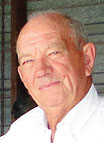
The week after graduating from Farmington High School, Jim Rieff became a meat cutter in Prairie Grove, Ark., at Southern Mercantile. Then in 1959, he was offered an opportunity to buy into a new grocery store in Rogers, Ark., if he would run the meat operation. Jim and Katie Rieff decided to do just that and still live on 40 acres they purchased in 1973 in Rogers. Little did he know back then that tractor restoring would become an important hobby.
Auction Action
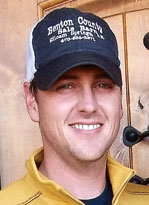
Paul Vaughn returned to Oklahoma after serving in the Army to start his cattle legacy. “I am sure my grandfather had some cattle but, it wasn’t at a large scale until dad,” Paul’s youngest son, Cody said. Paul started buying land and cattle raising strawberries to help pay for land, clearing it and buying cattle. During that time, Paul married Cammela and they raised five children. “There are five of us kids, four boys and one girl. Randy is the oldest. Marty and Olin were next. Then came Cammy and me,” Cody said. “I was an accident they tell me.
Planting the Seeds of Farm Knowledge
Now that the United States Department of Agriculture’s (USDA) Farm to School Month in October has come to a close, school districts throughout the United States still have an opportunity to participate. The program benefits the schools, nonprofit entities and the local farmer, rancher and/or grower. The grant provides assistance to eligible entities who want to implement farm-to-school programs to improve access to local food sources. The USDA awards up to $5 million in competitive grants annually for training, support, planning, equipment purchases, school gardens, partnerships and the implementation of farm to school programs.

A Solid Saler Foundation
Ron and Shelley Terrell have been married for 14 years and have a son, Damien, who is 10. Ron was raised on a farm in Stilwell, Okla. Shelley is from Chouteau, Okla.
Young and Determined
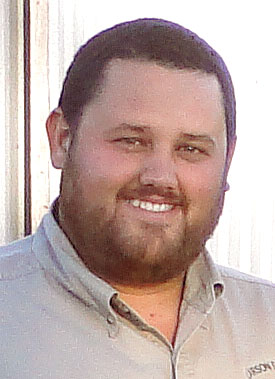
Austin and Kayla Pratt live outside of Harrison, Ark., and are starting a new farm, a daunting task in this day and age. They rent 200 acres on a family farm dating back to 1845 when the land was first purchased by Kayla’s great, great, great grandfather David Trotter.