

The Renshaw family focuses on the Australian White breed of sheep
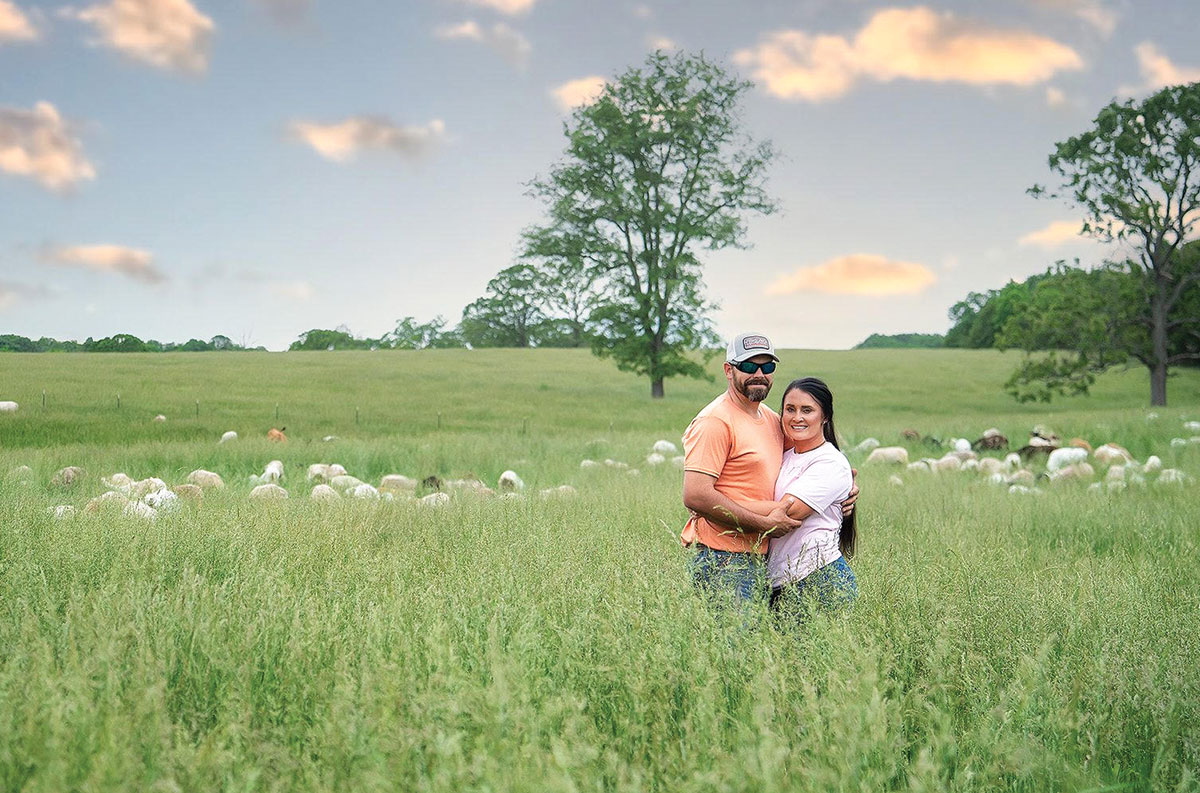
WEST PLAINS, MO. – It’s not uncommon for agricultural endeavors to be a family affair, often dating back generations. This is no different for Ryan and Marque Renshaw, owners of Peace in the Valley Farms, a sheep operation located just outside West Plains, Mo.
Both halves of the married couple can trace their lineage back to farming roots. Both Ryan and Marque were raised on cow-calf operations, but Marque has special connections to Ovis aries, the scientific term for domestic sheep.
For decades, the women in Marque’s family have been shepherdesses.
“My aunt would tell me stories about women in our past generations who left their families behind to shepherd in the mountains,” Marque said.
The Renshaws managed a cattle and equine operation in conjunction with Peace in the Valley. However, in 2022, the family received a sobering reminder of what’s truly important when a house fire destroyed everything they owned.
In the aftermath of the fire, Ryan and Marque decided to cut ties to their former operations. They sold all components of Renshaw Farms – the horses, the cattle, everything. They purchased a new home on just over 80 acres of farmland.
“We dove straight into our flock,” the Renshaws said. “We brought around 300 ewes to our farm that summer and fall.”
Marque said they purchased the best rams they could afford, starting their flock with Dorper and Katahdin crosses, which they expanded over time. However, they soon realized they weren’t content with these genetics.
“At that time, I had been following Tattykeel, a sheep breeder in Australia, for a couple of years,” Marque said, referring to the breeder’s focus on Australian White sheep, a meat breed known for its adaptability, excellent eating qualities, and nutritional value.
Little did they know that the solution was right here in the United States. Serendipity struck when a family friend listed his Australian White flock for sale online.
The flock was listed at sale barn price, so the Renshaws jumped on the opportunity. They purchased the entire flock, including the ram. Lambing season began soon after, and although the Dorper x Katahdin performed at a decent rate, the Australian Whites surpassed them in nearly every way.
“After birth, the lambs would jump up, and we’d have to chase them down for processing,” the Renshaws said. “It was unlike anything we had ever seen.”
This was just the beginning. The growth rate of these lambs proved to be exponential and exceeded the Renshaws’ expectations. What’s more is that these sheep were raised entirely on pasture, never eating a kernel of grain.
“We will continue with this breed because a lamb that can hit market weights in two months, with little to no input cost,” the Renshaws said.
Marque added that the focus of the operation is now solely on adding more Australian White genetics into their flock.
Marque said she went directly to Tattykeel, where she was referred to the American Australian White Sheep Breeders Association (AAWSBA). From there, she was able to gather the contact information for leaders in the Australian White industry, including David Crider, Vice President of the AAWSBA, and Russell Schmidt, owner of Serenity Sheep Farm, located in Southwest Mississippi.
With that, Marque loaded up her truck and got on the road for what would become a three-day round trip to each of the Australian White Sheep farms. At each location, Marque interviewed the breeders and carefully examined the sheep, all the while gathering important information that would inform her decision.
She returned home with the first set of purebred AAWSBA-registered rams.
“From that day forward,” she said, “there would be nothing but Australian White rams on our farm.”

Due to the shortage of true Australian Whites in the United States, Marque said that the most effective forms of breeding are embryo transplant or purchase. To ensure that their flock maintains its purebred status, Peace in the Valley’s breeding program combines live breeding and embryo transfer.
“We believe that the Australian White breed will improve uniformity in our flock,” Marque said. “It’s a process, year-by-year, that we cull those that do not meet our requirements and replace them with genetics that do.”
Currently, Peace in the Valley Farms comprises approximately 300 ewes at any given time. Marque said that, in the future, she and her husband hope to increase this number to around 700.
The Renshaws utilize rotational grazing as their primary agricultural practice, with all sheep grazing on quality orchard grass, crabgrass, and clover.
“The biggest success story on our farm is our rotational grazing system,” the Renshaws said. “It changed everything for us.”
Rotational grazing is not only good for the land and the animals – it’s good for a farmer’s pocketbook. Wormers and medicines can compound the already existing costs a farmer incurs; rotational grazing, Marque said, can help ease this burden by providing livestock with healthier options, thus decreasing the chances for worms and other parasites and diseases.
Marque stated that the farm vaccinates its sheep for almost any sort of ailment.
“You name it, I would say we give it,” she remarked. “By the time you add up the money lost in dead sheep, it’s generally cheaper for the vaccination.”
Hoofcare is also a top priority. The grass on which the sheep are raised is plentiful; according to Marque, the thick undergrowth is knee-high, and the moisture it holds is a surefire way to create some hoof issues.
“We knew this was going to be a big issue,” she said, “so what we have done is wait to rotate until mid-day, when the sun has taken some of that moisture out.”
“Every aspect of farming is based on the health and happiness of every hoof on our property,” Marque said. “If we want these animals to perform at the top, we have to give them everything they need to do so.
“The Good Lord Above has blessed us beyond belief, and He continues to do so,” Marque said. “The sky is the limit for how far we want to go in this industry.”