

Storytelling is one of the world’s greatest gifts. For generations, storytelling has been a highly valuable tool for passing on tradition, chronicling history and connecting with others.
For Justin Elliott, the stories he shares begin with the zoom of a lens, the flicker of a flash and the click of a shutter. Each meticulously crafted photo reflects passion, joy and creativity.
Elliott was involved in art from a very young age. He took art classes throughout his childhood education, and his father even signed him up for several art camps to broaden his exposure to the art world and experiment with different mediums.
“I’ve always had a bit of a creative bent,” Elliott shared with a chuckle.
However, his love for photography did not fully develop until later.

“I never really found anything I loved until my sophomore year of college. I signed up for a photography class,” he reminisced. “It turned out, I loved it.”
As life got busier, Elliott had less time to spend with a camera in hand. Even still, he found himself continually going back to the darkroom to develop film and see his photos come to life.
“I kind of pursued it off and on over the years, but in the last ten years or so, I rededicated myself to photography,” he said.
Since this renewed focus, Elliott has shot many different subjects, although few are as unique as his barn photos. He said his inspiration came from a conversation with a friend and fellow photographer in which he suggested using barns as photo subjects.
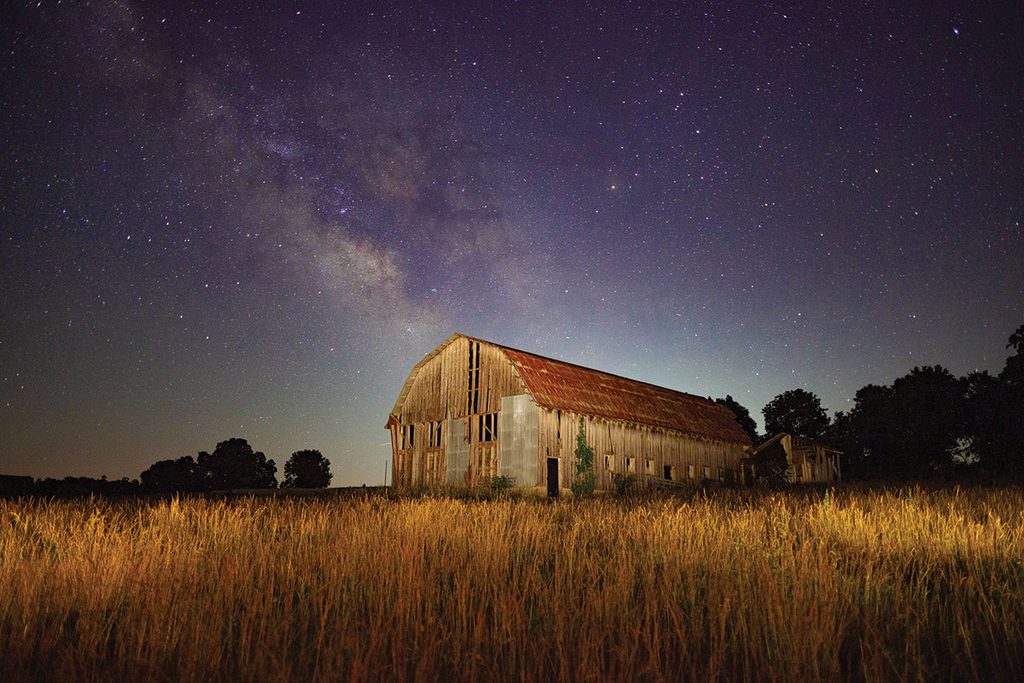
The idea eventually gave birth to “Barnstorming the Ozarks”. Over the course of a decade, Elliott built a portfolio to showcase barns across the Ozarks region. His weekends were spent scouting out locations, considering aspects such as seasons, flora, fauna and even the night sky.
“A good photograph of the Milky Way is incredible on its own, and a photograph of a barn on its own maybe isn’t so incredible, but you put the two together, and you get a really spectacular shot!” Elliott emphasized.
While Elliott was able to achieve beautiful photography through intentional searches, many of his photos are the result of serendipity – being in the right place at the right time.

“I may not know exactly what I’m looking for, but I kind of know what it is when I see it. I feel like it’s divinely inspired,” Elliott said with confidence.
Whether sought after or stumbled upon, each of his photos share a distinct feature: every barn is picturesquely rustic, antiquated or even dilapidated.
“I really gravitate towards the older barns because they have that character that only an old barn has,” he said. “It’s withstood 75 or 100 years, or even more, and taken a beating from the elements and life in general. There’s something about that worn wood and missing piece of roof that just makes it kind of appealing.”
Behind each barn he photographed, there were landowners who played a crucial role in Elliott’s journey. He had to acquire their permission before taking a photo, and each connection began by sharing both his photos and his passion. He said for many, it meant a lot to them for someone else to recognize the beauty they knew existed all along.
“It’s a fun thing for me to share with landowners and property owners, and it’s a memento for them,” Elliott said.
In one case, when Elliott went back to a landowner’s house to give them the photo of their barn, he ended up sitting for hours on their porch, hearing stories about the memories the barn held and the history it represented.
“Many of these folks love to share these stories about their barns. You get an intimate look at not just the barns, but the families and properties. It makes you think of all the years these families have spent cultivating and making the land into what it is,” Elliott reflected. “It’s a very satisfying aspect from my perspective.”
From these conversations, Elliott learned that every barn tells a story, and without them, we lose a connection we once held with the land. Unfortunately, these barns are rapidly disappearing from the Ozarks.
“It makes me sad in some ways. I remember the first barn that I was intentional about what I wanted to shoot. A couple years went by, and I was driving along that road, looking forward to seeing it, and it had been taken down. It was kind of heartbreaking,” Elliott lamented. “Someone didn’t see the same value in it that I did.”

While the disappearance of barns from the Ozark landscape is a sobering reality, with each new photo, Elliott has the opportunity to not only preserve a piece of history, but illustrate a meaningful part of people’s lives.
“I hope maybe it evokes a feeling of nostalgia or takes them to a place that is satisfying for them in the same way I found it satisfying – that there is a comfort of home,” Elliott said.
Every new photo Elliott shares is returned with a smile, a laugh or, in some cases, even happy tears. Each reaction stems from memories of meaningful moments or a mutual appreciation of rugged beauty.
As much as his photography is meant to be shared with others, Elliott has also discovered more about himself in the process. Not only did he learn more about the historic Ozarks through the development of his portfolio, but he also reignited the passion he had for the Ozarks, agriculture and photography in general.
“It’s made me love it even more. It’s really given me more of a desire to dive deeper,” he said. “I don’t know what I can do, but I’d love to see a revitalization of certain agricultural industries so that the next generation of photographers can have something to go out and photograph too.”
The future of many historic barns still remains uncertain. However, through barnstorming the Ozarks, Elliott is doing his part to give a voice to the history, landowners and the barns that continue to define the region’s character.