

Thriving in harsh environments
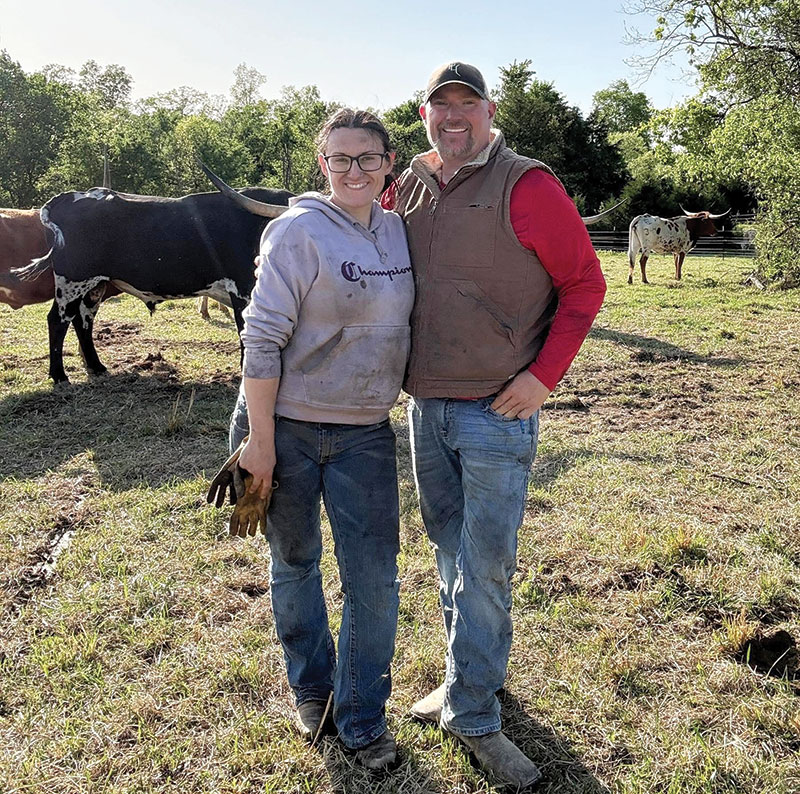
WEST PLAINS, MO. – Perhaps there is no more recognizable symbol of the American West than the Texas Longhorn and they certainly represent the beginning of the American cattle industry—Andrew and Kevin Painter of Painter Livestock Company are well-aware of both.
The brothers grew up around livestock on ranches in Texas, Oklahoma and northern Arkansas and today Andrew and his family reside in Dora in Ozark County and Kevin is 20 miles away in West Plains in Howell County.
“Our grandfather, M.L. White raised commercial hogs and cattle and our dad, Rickey raised various livestock throughout his life,” Andrew Painter explained. “The three of us, my dad, my brother and I started the Painter Livestock Company in 2000. We bought our first livestock together, three registered horses.”
In 2025, the two brothers decided to honor the men in their family who had come before them in this business by reviving the Painter Livestock Company. They bought a tri-colored roan Longhorn in an online auction.
“Our plan,” Andrew continued, “was to use her for cross-breeding beef but we absolutely fell in love with her. I’ve been around cattle all my life but she has an incredible personality and we soon found ourselves raising registered Texas Longhorns for high-genetic stock.
“My brother and I are third generation ranchers raising Texas Longhorn stock with a strong focus on conformation, horn, feet, mothering ability and disposition. We are not about chasing 100” horns with little thought to everything else. We’re working to produce high-genetic, complete cattle our clients can be proud of.
“Our head sire, BR Black Magic XL is an over 80” Homozygous black bull. Every calf he produces will be black, black and white or possibly grulla, which is a striking smoke slate-gray or mouse-colored coat. That makes him the 29th largest tip to tip true black bull in the history of Longhorns. There have only been 33 recorded bulls that are over 80” and true black. BR Black Magic XL is only 5 years old and a rarity in Longhorns as Homozygous, all black from both sides.” Andrew continued. “Longhorns will eat nearly anything. They will eat a lot of forage that other breeds won’t touch. They are not quite a goat but not far off. They thrive on being in harsh environments, including drought and can still convert that forage to weight.

“Our feed program consists of good forage, clean water and daily supplement feed to aid in growth and development. We also use free choice mineral, both loose and in tubs to aid in deficiencies.
“Finally,” he added, “we market everything from our website and social media. Longhorns live to be 20+ years old and all of ours are very young, five and under except for one cow. So, while eventually we’ll get around to marketing horns and hides, it’s going to be a while.”
He continued to share a bit about the history of the breed. “The Texas Longhorn is a historic breed that fed our nation in its formative years with the first major cattle herds. The Longhorns are descended from the Spanish Retino (Criollo) stock brought to the Americas in 1493. By the 1600s, Longhorns were in the territory that is now present-day Texas. They are actually the closest we have to our own native American breed where the Angus, Charolais and other breeds are originally from Europe and were brought over here much later.
“We raise high genetic calves for people to start or add to their own herds and we travel around to futurity shows in Texas, Oklahoma, Wisconsin, Michigan, and Kentucky.
“We show cattle and the Longhorns are scored on a scale, by five judges on a point system. Longhorns can be a challenge when it comes to moving them. They require specialized equipment to accommodate those horns, like 10-foot-wide alleyways and specialized Longhorn chutes. They will swat flies with their tails like all cows but also with those horns, so you have to watch where you are when they move like that,” he added with a laugh.
Andrew added. “We look for confirmation in our cattle but disposition is also one of the main components that we want. Most Longhorns are very friendly and you need that in an animal built like this. We don’t keep them if they are difficult or the least bit crazy.”
Andrew was in FFA while in school and today, he works for a lumber company out of Wisconsin, doing remote sales which has allowed him to be out on their ranch of a little over 80 acres every day. Kevin is in sales with Global Medical Response and Katie and Karen both work as RN’s as they both work toward their nurse practitioner certification. They also sell farm-to-table beef, pasture-raised poultry and pork as well as fresh eggs to the community.
Their kids also play a part in the Painter Livestock Company. Andrew and Katie’s son, ten-year-old Noah and five-year-old daughter, Charlie as well as Kevin and Karen’s children, Journey and Kennedy are learning about the livestock business during their formative years. They all love being at the farm and contributing in whatever way they can, Andrew shared.
“It’s a joy to see the next generation enjoying this historic breed,” he concluded. “We just completed a 13,000 square foot corral but we also have some of our stock out in the pasture along where a county road meets the state highway. We see cars lined up all the time where people just stop to watch these Texas Longhorn cattle, standing out there in the pasture. They truly are very majestic animals.”