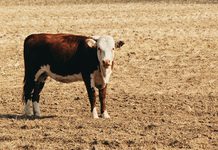


Farmers are turning to holistic planned grazing to restore soil health and boost biodiversity.
Heifer Ranch, a farm in Perryville, Arkansas, uses a regenerative agriculture approach when tending to its cattle, pigs, and sheep. Donna Kilpatrick, director of regeneration at Heifer Ranch, explains the key to their success is rotational grazing, monitoring pasture quality, and allowing for proper land rest.
“We use holistic planned grazing,” Kilpatrick said. “It’s designed to restore grasslands through well-managed grazing that allows forage the proper recovery time before animals go back on the land.”
This system emphasizes strategic rotation, where animals move daily to different paddocks to ensure the land receives just enough trampling and mowing, leaving a layer of residual grass to protect the soil.
“Our animals move every day to a different paddock. A paddock isn’t necessarily a pasture,” Kilpatrick said. “A pasture can be divided into 20 paddocks.”
Kilpatrick hopes to use the livestock to tear up the soil to allow new growth and movement.
“We’re trying to get that herd effect, trampling, moving, mowing, etc. where just enough is left behind where you have a nice layer of residual grass that covers the soil.”
Regular assessments of soil health, forage performance, and animal well-being are integral to their practice. Rest periods for pastures are also critical, particularly in fast-growing seasons, where livestock are rotated after 30 days, and up to 90 days in the non-growing season.
“The biggest thing about holistic management is rest,” Kilpatrick said, “The pasture has to rest like people do.”
In addition to grazing management, Heifer Ranch focuses on planting diverse forage species to boost soil resilience.
“We planted spring annuals like brassicas and bird’s-foot trefoil and a variety of forbs to build biodiversity and improve livestock health,” Kilpatrick said.
She explained that more plant diversity leads to more resilient soil, helping the land recover from past overgrazing.
“We try to prevent any bare soil. We want there to be enough foliage on the ground so each animal bites a blade of grass once, so it doesn’t harm the root system.”
Kilpatrick advised farmers to start small when implementing regenerative practices.
“Start by separating parts of your pasture and give the land a break. Don’t try to do everything at once,” Kilpatrick said.
To learn more about regenerative agriculture and how to implement it in home operations, visit local extension office websites.