
Much of what I know about animals I learned from a pig.
I started junior high school at Fair Grove in the fall of 1959, and though it was not an official FFA chapter, I enrolled in junior FFA.
It wasn’t quite like the high school version. We didn’t have officers or regular meetings, other than with the vo-ag teacher. The main thing I recall is we had to have a project, just the same as full-fledged members. I think that was the whole idea of the class – preparing us for FFA as freshmen.
We never had hogs on the place, but Dad suggested a pig would be a good project for me. Unlike the calves I helped raise or the cows I milked every day, the pig would actually be my own.
Down the road about a mile was a fellow who raised hogs, and I suppose Dad had talked to him even before the evening we went down to pick up a weanling pig. I can remember everything about that coal black Hampshire/Poland cross but her name. For purposes of this tale I’ll just call her “Babe.” Trying to recall her name has frustrated me for years. I can still picture her plain as day, but not what I called her.
Anyway, a nameless little gilt at first, I easily carried her home in a tow sack and kept her in an old school bus body. It made the perfect pen and shelter at the same time, but for the lack of a proper gate. It took only one escape and a missed day of school to remedy that.
That was the first thing she taught me – pigs are fast runners and hard to catch, especially in the woods.
Within a few months we built a proper pen of hog wire in the corner of a woods across from the barn lot. We later replaced that pen with a half-acre lot enclosed with an electric fence.
We had used electric wires to divide our cow pastures for years, but never built low enough to step over. That taught me another thing about hogs – they’re quick learners. One encounter with hot wire, and Babe never put her nose to it again. In fact, when we enlarged the pen it took her several days to cross the former fence line. After high school I worked on a hog farm that utilized electric fences extensively, so I guess we likely weren’t the first. But it was new to me in 1960.
Raising Babe from weaning to maturity also taught me a lot of about the nature of hogs – they’re not much different from dogs. Given a bit of attention, they can become pets. Babe, for example, loved to have her back scratched, just like every dog I’ve owned. When I first saw the TV pig Arnold steal the show on “Green Acres,” I knew it was entirely plausible. The difference between pigs and dogs is what do with them when they’re grown. That said, I still love pork chops, ham and bacon – just the same as I still eat steaks and hamburger from calves I’ve fattened. I guess it’s just a farm thing some city folk will never understand.
I also saw in Babe how resourceful hogs can be. Running free on a large lot, she gathered sticks and brush to build herself a bed – more of a nest, actually – before I could get her house built.
When I did build one is was made of oak slabs from a local mill. Babe was likely the only pig in the county with a log cabin in the woods.
The plan for Babe was to get her bred and raise more pigs, but that never happened. The second year we gave up on getting her to a boar. Rather, Dad loaded her up one day while I was in school and hauled her to the Springfield Stockyards. He told me she brought a top of the market price – 18 cents a pound, I think – and weighed in at 300 pounds.
For my part, Dad bought me a new fishing reel.
I reckon he thought he was owed something for the feed he bought, and he was, even if Babe got the same 18 percent dairy ration as our milk cows.
It was never a money-making deal, anyway. I guess that was a part of my ag education, too.
Still, I have warm memories of my pet hog waiting to be fed at the corner of her lot every evening, waving her feed bucket in her mouth – never too early, never to late, always right on time.
I can see her in my mind, now. I just can’t remember her name.
I kept that aluminum bucket around for years, Babe’s teeth marks still embedded in the soft metal, a mute reminder of my first experience as a pig farmer and the Hamp/Poland gilt who taught me that hogs were smarter than I knew.
Copyright 2026, James E. Hamilton, P.O.Box 801, Buffalo, MO 65622
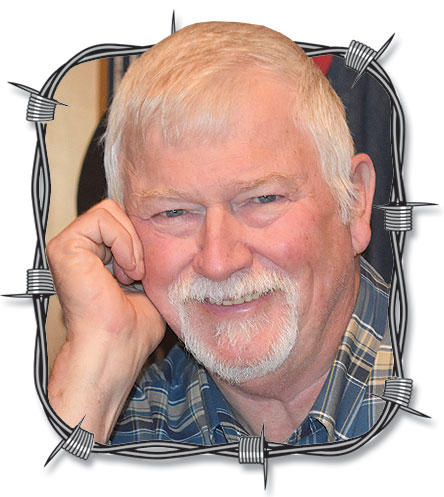
A former feature writer for Ozarks Farm and Neighbor, Jim Hamilton is a retired newspaper editor/publisher. Hamilton was reared on a small dairy farm in Dallas County, Mo. Contact Jim at [email protected].